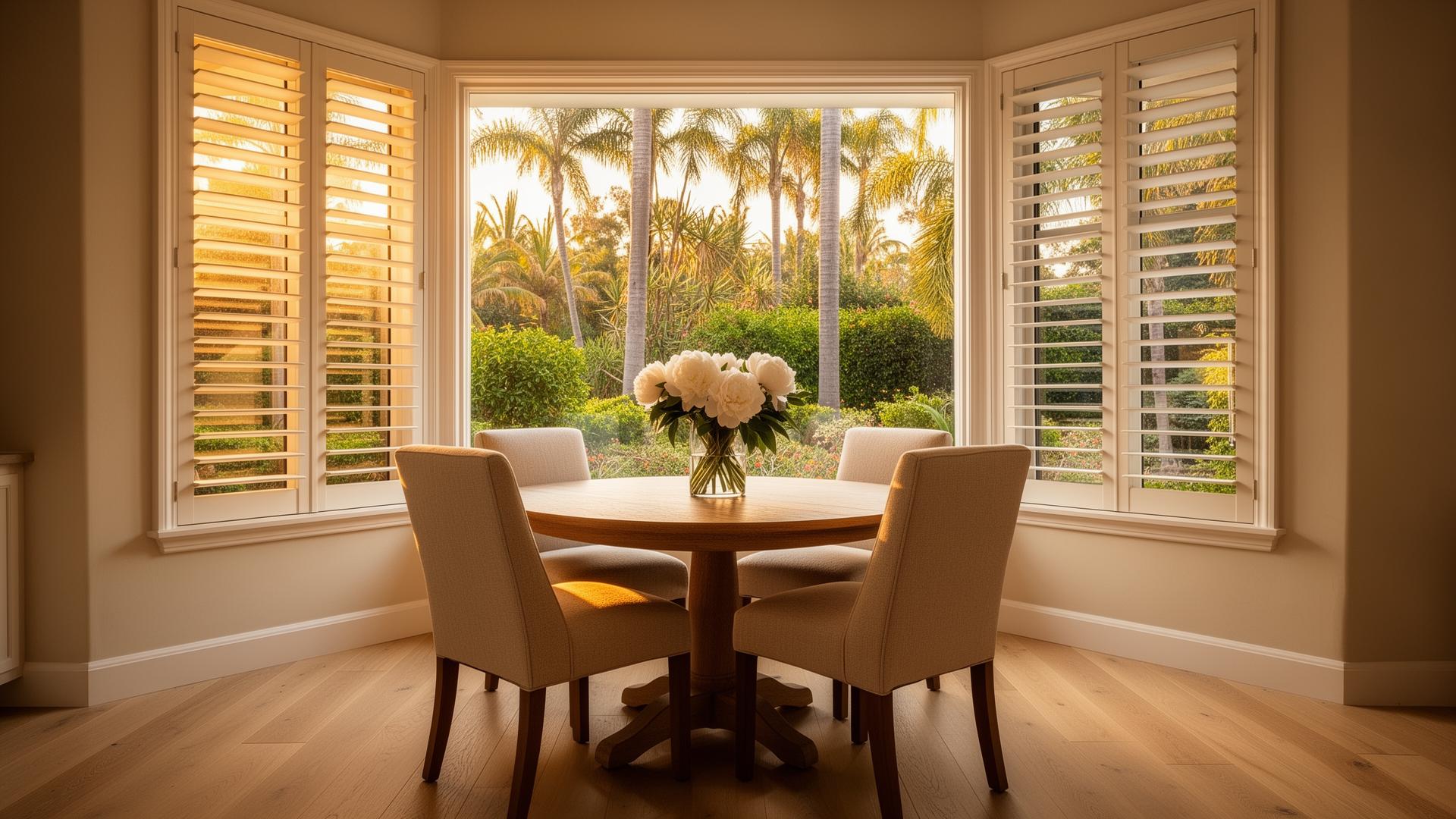
Design Guide
Plantation shutters and curtains.
How to layer them beautifully.
Shutters do the heavy lifting — privacy, insulation, light control. Curtains add softness, texture, and warmth. Here's how our designers combine the two without making a window feel busy.
Why pair plantation shutters with curtains at all?
On their own, plantation shutters are architectural — clean lines, tailored louvers, a built-in feel. Add curtains and the same window suddenly feels furnished. The fabric softens hard edges, ties the window into your upholstery and rugs, and gives the eye somewhere to land between the louvers and the ceiling.
It is also a practical move. Shutters handle daylight and privacy; floor-length drapery absorbs sound, helps with insulation around large openings, and lets you fully blackout a bedroom on demand.
Mix textures, not patterns
The shutters are already a strong visual element. Let the curtain do something the shutters cannot: drape, fold, catch light. We almost always specify a textured solid over a busy print.
- Linen or linen-blend against painted white shutters — warm, slightly irregular weave, very Southern California.
- Heavier wool or velvet against hardwood or knotty alder shutters — picks up the depth of the stained grain.
- Sheer linen or voile if your shutters already do all the privacy work and you just want to filter light at sunset.
Manage the light in layers
Think of it as three independent dials: louver tilt, shutter panel position, and curtain draw. Most rooms only need two of the three at a time.
- Morning: louvers tilted up to bounce light off the ceiling, curtains pulled fully open at the sides.
- Afternoon glare: close the louvers, leave the curtains open — the shutters cut the heat without darkening the room.
- Evening: open the louvers for the view, draw the curtains partially for warmth and acoustic softness.
- Sleeping: shutters closed, curtains fully drawn — effectively blackout, with double the insulation against early sun.
Color: match the wall, not the shutters
The most common mistake we see is matching curtains to the shutter color — white-on-white usually reads as flat and hospital-like. Instead, pick a curtain a half-shade off your wall color. The shutters frame the window; the curtains fade into the room around it. Your eye registers the window as architecture, not as a fabric statement.
Stained wood shutters are the exception — there, a curtain that picks up an accent from your rug or sofa ties the whole room together.
Hang the rod high and wide
Mount the curtain rod a few inches below the ceiling and extend it 6–12 inches past each side of the window frame. When the curtains are open, the fabric stacks on the wall — not over the shutters. You keep the full louver view, full daylight, and the room feels taller.
For floor-length drapery, the hem should just kiss the floor — about a quarter inch above for everyday rooms, a slight break for formal living rooms.
Rooms where the pairing shines
- Primary bedrooms — shutters for privacy, blackout curtains for sleep.
- Formal living & dining rooms — adds the softness a furnished room needs without losing the architectural feel.
- Tall west-facing windows — shutters handle afternoon glare, drapery handles the sound reflection from large glass.
When to skip the curtains
Small windows, kitchens, bathrooms, and any room where floor-length fabric would feel forced — the shutters alone are cleaner. Curtains belong in rooms with the wall space and the ceiling height to wear them well.
Want help specifying the pairing?
Our in-home consultations cover both shutters and the drapery hardware they sit behind. We'll bring samples, measure everything, and recommend the right fabric weight and color for your room — no obligation.
Book Free Consultation